
TL;DR
- Delve requires managing sulphite fuel and darkness mechanics while following the mine cart
- Azurite upgrades for darkness resistance and light radius are essential for progression
- Fossil crafting provides surgical item modification by blocking unwanted affixes
- Hidden nodes follow specific connection rules that eliminate guesswork
- Endless Delve removes sulphite limitations but adds significant crafting restrictions
Welcome, exiles! This comprehensive guide from mmogah.com will transform you from a Delve novice into an underground expert. We’ll explore core mechanics, advanced fossil crafting, hidden node strategies, and the unique Endless Delve race format.
Getting Started with Delve
Originally introduced as a league mechanic over two years ago, Delve has become one of Path of Exile’s most beloved and enduring systems. You’ll first encounter the NPC Niko in Act 4, who becomes your gateway to the Azurite Mine. After this initial meeting, Niko can appear on virtually any map during both the campaign and endgame Atlas progression.
When you find Niko during mapping, he’ll spawn three voltaxic sulphite deposits. This sulphite serves as the essential fuel that powers your mine cart, enabling deeper exploration into the underground network.
Upon meeting Niko, you gain access to the mine encampment—your operational base for all Delve activities. From here, you access the sprawling mine itself: an enormous interconnected web of nodes linked by tunnels that extend downward and horizontally in all directions.
The mine cart (or crawler) becomes your mobile sanctuary and guide. It consumes sulphite as it moves between checkpoint nodes, operating autonomously as long as you remain within its protective radius. If you fall behind or venture too far, the cart will pause and await your return.
Critical safety tip: The cart emits a protective light field that shields you from the deadly darkness. Stepping outside this illuminated zone triggers a stacking damage-over-time debuff that escalates rapidly. However, returning to any light source—whether from the cart, flares, or illuminated pads—instantly clears all accumulated darkness stacks.
When the crawler reaches your selected destination node, you’ll typically face multiple waves of monsters. Successfully clearing these encounters rewards you with a satisfying loot explosion and access to specialized treasure containers corresponding to the node type you’ve completed.
Azurite & Spending Azurite
As you survey your Delve map, you’ll notice distinctive blue Azurite nodes available in three tier variations. Completing these nodes rewards you with Azurite—the exclusive currency used for purchasing critical upgrades at the Voltaxic Generator within your mine encampment.
Priority upgrade: Increase your sulphite capacity first. This allows more efficient mapping sessions without frequent interruptions to delve and consume accumulated sulphite.
Darkness resistance represents a crucial defensive stat exclusive to Delve content. While it caps at 75%, descending deeper into the mine imposes progressively severe penalties to your darkness resistance. You must continually upgrade this stat to maintain effective protection against the encroaching darkness.
Light radius expansion significantly increases the illuminated safety zone around both your mine cart and the permanent lights connecting completed nodes. This stat reaches its maximum at 150% and, similar to darkness resistance, requires constant enhancement to counter depth-based penalties.
Flares serve as consumable emergency light sources that create temporary safe zones when thrown. Positioning yourself near an active flare instantly clears existing darkness stacks and prevents new ones from accumulating.
Beyond upgrading your flare capacity, duration, and illumination area, Azurite also purchases additional flares from Niko’s inventory.
Flares & Hidden Areas (Fractured Walls)
Why carry flares when the mine cart provides illumination? The answer lies in the most lucrative Delve rewards, typically found within dark side areas completely separate from the main pathways.
These hidden zones range from compact pockets to extensive labyrinthine corridors packed with enemies, often requiring multiple flares for safe navigation and survival.
A specialized dark area type remains concealed behind destructible fractured walls. These barriers become visible on your minimap at close proximity, with their outlines highlighting when you mouse over them.
Fossils & Crafting
Fractured walls require demolition using dynamite, available for purchase and upgrade at the Voltaxic Generator.
Dark regions, particularly those concealed behind fractured barriers, contain Delve-exclusive crafting materials: fossils and resonators.
The fossil system includes 25 distinct types, each modifying crafting outcomes in specific ways. For instance, metallic fossils enhance lightning modifier probabilities while completely blocking physical affixes.
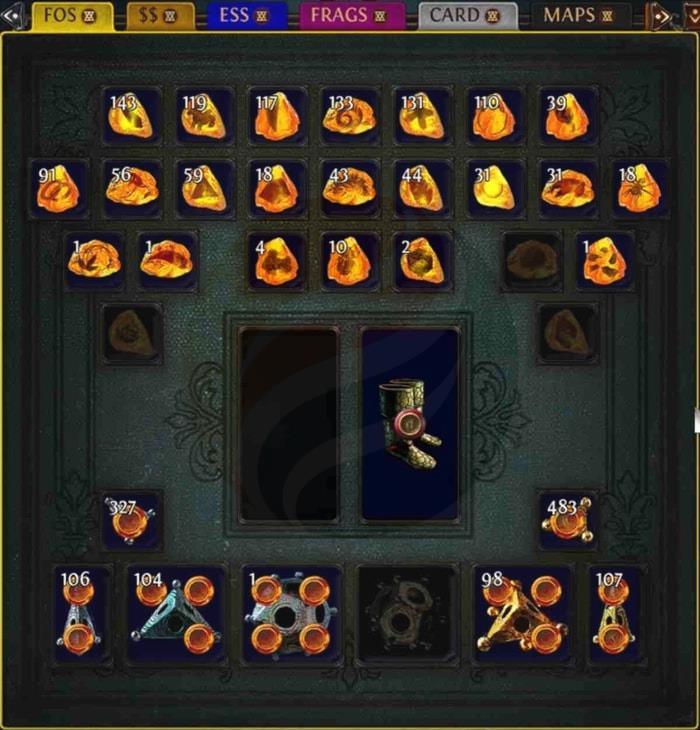
Unlike standard crafting currencies, fossils cannot be applied directly to items. They must first be socketed into resonators—specialized tools available with 1 to 4 sockets, enabling combined fossil effects in single crafting attempts.
Consider this practical scenario: crafting optimal boots targeting movement speed, maximum life, and elemental resistances.
Using Chaos Orbs for random modification proves extremely inefficient and expensive, given the microscopic probability of hitting all desired stats simultaneously.
Why select Shuddering, Pristine, and Prismatic fossils specifically? Movement speed represents the sole speed modifier available on non-influenced boots. Shuddering fossils directly boost movement speed probability while preventing mana modifiers from appearing.
Maximum life and life regeneration constitute the only life-related modifiers possible on boots. Blocking armor, evasion, and energy shield modifiers (defensive categories) similarly reduces the available affix pool, indirectly improving chances for your targeted stats.
Elemental resistances represent the exclusive elemental modifiers rollable on standard boots, justifying the Prismatic fossil selection.
Advanced crafting insight: Combining fossils strategically narrows the possible outcome pool dramatically compared to random crafting methods.
Delve Cities
Delve cities represent special node clusters typically spawning within distinct yellow-bordered zones on your map.
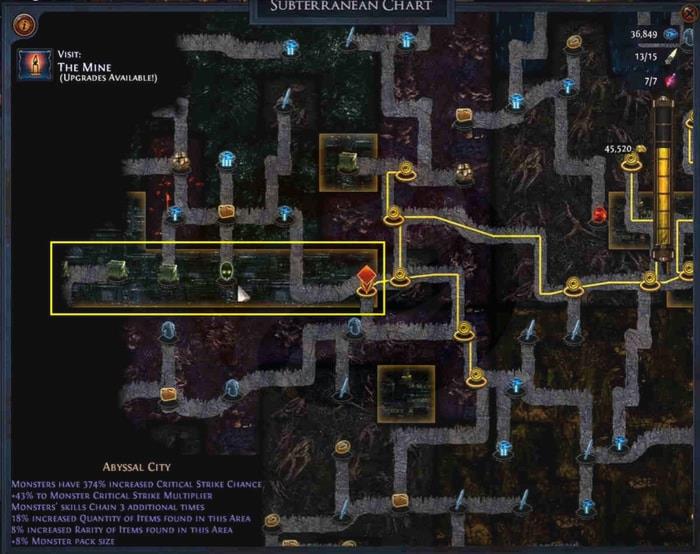
Each city node contains an expansive underground chamber packed with numerous treasure chests offering diverse rewards.
These chambers feature built-in light activation pads—stand on them briefly to illuminate dark room sections, enabling elimination of lurking monsters. While flares remain an option, these pads provide illumination completely free of resource cost.
Three distinct delve city types exist: Vaal outposts, abyssal cities, and primeval ruins, with the latter being exceptionally rare and challenging.
Hidden Nodes & How to Find the Routes
During mine exploration, you’ll discover hidden nodes lacking visible connecting pathways. In reality, these nodes always connect to adjacent nodes, but concealed fractured walls obscure these routes from your map view.
To access these concealed nodes, begin from a neighboring node and venture into the darkness until locating a destructible wall.
After demolishing the barrier, the pathway to the hidden node becomes visible, allowing mine cart travel.
Rather than random exploration from every adjacent node, employ systematic methodology based on Delve’s inherent pathing rules.
With minimal exceptions, Delve nodes connect via exactly 1, 3, or 4 pathways—never precisely 2 connections under normal circumstances.
Additionally, hidden node paths cannot intersect established roads. These two principles provide invaluable information that eliminates most candidate nodes.
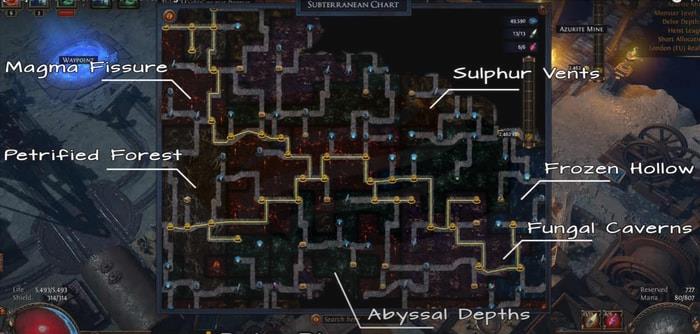
Nodes currently displaying single connections cannot lead to hidden nodes, as this would create exactly 2 connections, violating core pathing principles.
Delve Biomes
Beyond Delve cities, all standard nodes spawn within specific biomes indicated by distinctive background colors on your map interface.
The six primary biomes include: fungal caverns, petrified forest, abyssal depths, frozen hollow, magma fissure, and sulfur vents.
Biomes determine enemy types, area layouts, and influence specific fossil drop probabilities.
Frozen hollow biomes feature remarkably linear and uniform layouts. They predominantly spawn cold-damage dealing monsters and significantly increase frigid fossil discovery rates.
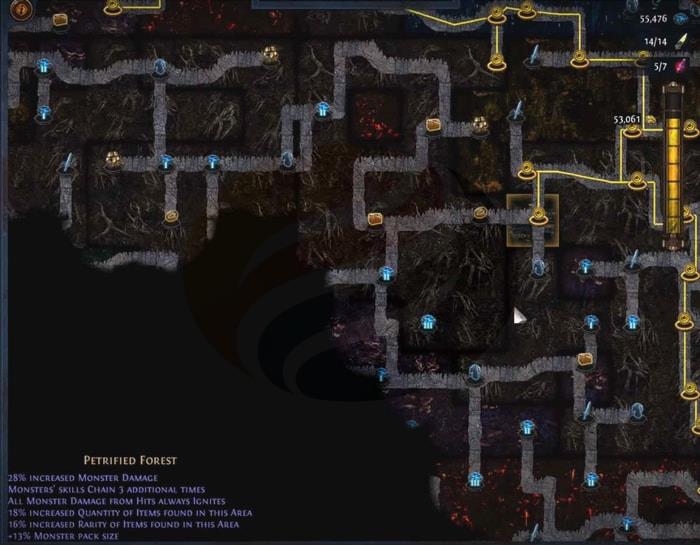
Conversely, Petrified forests present intricate maze-like configurations where bound and jagged fossils appear more frequently.
Specialized nodes exclusively spawn within particular biomes. For instance, “contains fire items” nodes always appear in magma fissure (fire) biomes exclusively.
Target farming strategy: If seeking specific items like “flammability curse on hit” rings, specifically target magma fissure biomes. This knowledge enables precise fossil and PoE Items targeting, particularly valuable in solo-self-found league environments.
Flares Keybinds
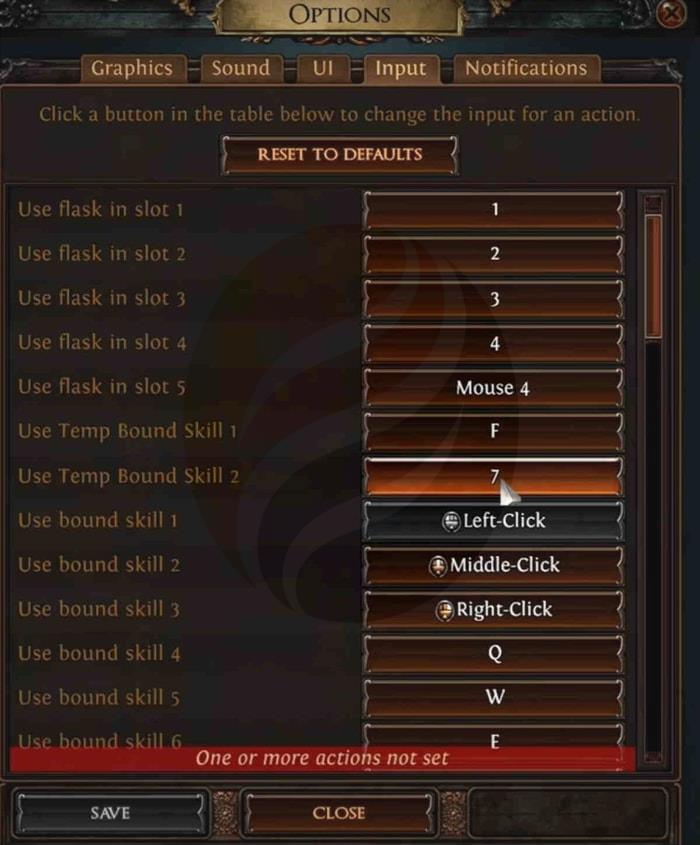
Default keybindings position flares and dynamite on the 6 and 7 keys—often inconveniently positioned for rapid emergency deployment.
Optimization tip: Reassign these critical functions by navigating to Options – Input and modifying “Use Temp Bound Skills” settings.
Endless Delve Race Info
The Endless Delve race operates as a completely separate one-week league, inaccessible to your existing characters and items.
An NPC vendor offering all standard skill gems will be available in the mine encampment, ensuring any skill remains playable.
Passive points normally acquired through campaign quests will instead be rewarded at specific delve depths or character level milestones.
Ascendancy points follow similar distribution patterns, while characters receive the standard -60% resistance penalties equivalent to those applied after defeating Kitava in Acts 5 and 10.
Each character begins with specially designed unique items. While class-specific (rangers typically receiving bow and quiver combinations), you can create multiple characters and transfer items via shared stash.
Despite these quality-of-life enhancements, numerous systems remain unavailable: hideout crafting bench, Pantheon powers, cluster jewels, Alva’s temple, timeless jewels, conqueror influenced items, anointing, catalysts, beast crafting, Heist, and more.
Crafting limitations restrict you to fossils, essences, and standard PoE Currency.
Critical limitation: While divination cards will drop, no NPC exists to redeem them. Similarly, silver coins and prophecies remain unusable despite dropping.
Atlas maps will also appear as drops, but without map device access, they serve no practical purpose.
Obtaining 6-linked items proves exceptionally challenging, primarily dependent on luck. Realistic expectation: accept 5-linked items as viable alternatives.
Preparation advice: Locate high item level, 6-socket bases and attempt linking using fusing orbs.
Linking probability tip: Item quality directly affects successful linking chances—aim for maximum 30% quality using perfect fossils before attempting.
Essential mindset adjustment: Your preferred builds likely won’t function without substantial adaptation for limited gear availability and maximum 5-link setups.
Action Checklist
- Rebind flares and dynamite to easily accessible keys for emergency use
- Prioritize Azurite upgrades: sulphite capacity → darkness resistance → light radius
- Practice systematic hidden node discovery using pathing rules
- Master fossil combinations for targeted crafting (Shuddering+Pristine+Prismatic for boots)
- Prepare build adaptations for Endless Delve with 5-link expectations
No reproduction without permission:GameCDjnh » Path of Exile Endless Delve: Delving Guide for Beginners Master Path of Exile's Delve mechanics with fossil crafting strategies and hidden node navigation