
TL;DR
- Complete Zana’s questline to unlock the Atlas and access endgame mapping content
- Strategic Atlas Passive Tree allocation dramatically increases farming efficiency and rewards
- Voidstones and map modifiers multiply your loot potential when used correctly
- Major boss encounters require specific preparation and mechanical execution
- Progressive map tier completion with proper investment yields exponential returns
Welcome to the definitive Path of Exile Atlas progression manual, your comprehensive roadmap to conquering the game’s most challenging endgame content. The Atlas of Worlds represents the pinnacle of POE gameplay, offering a complex network of interconnected maps that challenge even the most experienced players while providing access to the game’s most valuable treasures.
This guide delivers actionable strategies for navigating the Atlas efficiently, from initial access through defeating the most formidable bosses. You’ll discover optimization techniques that can reduce your progression time by up to 40% while maximizing your currency returns.

Atlas of Worlds Fundamentals
The Atlas of Worlds in Path of Exile serves as the primary endgame system, transforming your gameplay experience after completing the main campaign. This expansive mapping network provides structured progression through increasingly difficult content while offering substantial rewards for successful completion.
Gaining access requires completing Zana, Master Cartographer’s questline, which becomes available after finishing the main storyline. Once unlocked, you’ll interact with the Map Device in your hideout to begin your Atlas journey.
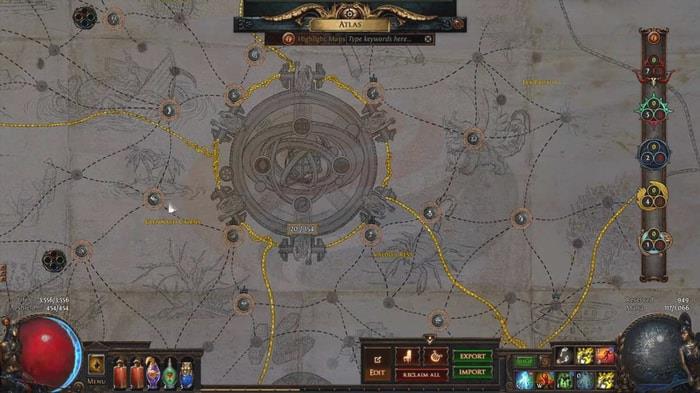
Understanding Map Tiers and Strategic Progression
Path of Exile’s Atlas organizes content through a tiered mapping system where difficulty and rewards scale proportionally. Each map tier presents unique challenges and opportunities for character development.
Here’s a strategic breakdown of map tiers and their optimization potential:
● Tier 1 to 5 (White Maps): These entry-level maps provide excellent character leveling opportunities and basic currency farming. White maps typically require minimal investment and serve as the foundation for your Atlas strategy.
● Tier 6 to 10 (Yellow Maps): Intermediate difficulty maps that introduce more complex mechanics and substantially better rewards. Players should ensure their build has at least 4,000 life or energy shield before attempting these.
● Tier 11 to 15 (Red Maps): High-tier content demanding optimized builds and proper gear. These maps offer significant currency returns and access to valuable league mechanics.
● Tier 16 (Endgame Maps): The most challenging regular maps requiring fully developed builds and strategic preparation.
Advanced players utilize currency items like Orbs of Alchemy and Chaos Orbs to shape their Atlas strategically, focusing on regions that align with their build strengths and farming objectives.
Your optimal map tier selection should balance clear speed, survivability, and reward potential. Many experienced players maintain a mix of yellow and red maps to optimize both experience gain and currency acquisition.
The Atlas Passive Tree represents a specialized skill system exclusive to the Atlas of Worlds expansion, functioning independently from your character’s main passive tree. This powerful customization tool allows you to enhance your mapping experience significantly by providing targeted bonuses and specialized benefits.
Unlike the character passive tree, the Atlas tree focuses exclusively on improving your endgame mapping efficiency, rewards, and encounter outcomes.
Strategic point allocation in the Atlas Passive Tree can dramatically increase your farming efficiency. Proper planning can yield up to 50% more valuable drops while reducing map completion time significantly.
Players accumulate Atlas passive points by completing specific objectives throughout their progression, including defeating certain bosses, clearing map tiers, and completing specific encounters.
The tree’s design emphasizes specialization, allowing you to tailor your Atlas experience to focus on specific content types that align with your build capabilities and farming goals.

Common strategic approaches include focusing on increased item quantity and rarity for general farming, boss-specific damage enhancements for guardian encounters, or league mechanic improvements for specialized content farming.
Advanced Atlas Progression Strategies
Systematic Atlas advancement requires strategic map completion and intelligent resource investment. Maps primarily drop from monsters throughout Wraeclast or can be acquired through player trading for targeted progression.
Progression follows a structured path through map tiers, requiring completion of all maps within a tier before accessing the next level of difficulty.
As you advance through the Atlas, you’ll encounter increasingly complex map modifiers that substantially increase difficulty while providing corresponding reward multipliers.
Strategic Region Conquest and Boss Preparation
Territorial control represents a crucial progression component, with different Elder Guardians dominating specific Atlas regions. Defeating these powerful entities is essential for advancing to subsequent regions and ultimately confronting the Elder himself.
Atlas Maps challenge players to demonstrate their mastery of Path of Exile’s combat systems while offering substantial rewards for successful completion.
A common mistake among new players is attempting to progress too quickly without proper build optimization. Ensure your character has adequate defensive layers (minimum 75% elemental resistances, positive chaos resistance, and appropriate life/energy shield values) before advancing to higher tier maps.
Atlas Map Modifiers and Optimization
Atlas Map modifiers constitute a sophisticated system of enhancements that dramatically alter map properties and rewards. These modifiers become accessible as players complete maps throughout the Atlas network.
Strategic Modifier Application and Risk Management
Modifiers encompass diverse effects including substantial monster density increases, item quantity and quality improvements, and enhanced boss encounter difficulty.
Players strategically apply these modifiers using various currency items, with the ability to stack multiple enhancements on individual maps for exponentially increased rewards.
Certain modifiers remain exclusive to specific map tiers, while others maintain universal applicability. Specialized modifiers often require quest completion or specific item usage to unlock their full potential.
Advanced players utilize modifier combinations to create specialized farming environments tailored to their build strengths and objectives.
Atlas Questlines and Beacon Mechanics
Upon reaching Yellow map tiers, new questlines emerge on your interface, positioned beneath the minimap. Completing these narrative arcs eventually unlocks the three Beacons on your map device, representing the Atlas’s primary storylines that culminate in epic boss confrontations.
The Atlas incorporates three major quest narratives:
● The Searing Exarch
● The Maven
● The Eater of Worlds
The Searing Exarch: Fire Dominance and Tactical Countermeasures
The Searing Exarch represents a formidable unique entity within Path of Exile’s bestiary, classified among the Exarch category of spellcasting adversaries originating from the Temple of Atzoatl during the Incursion league. This fiery combatant specializes in pyrotechnic assaults and conjuring incendiary minions to overwhelm opponents.
This adversary executes devastating flame wave techniques capable of inflicting substantial damage to players within their trajectory. Vanquishing The Searing Exarch becomes imperative for advancement through the Temple of Atzoatl and acquisition of valuable loot. Similar to other unique monsters throughout Path of Exile, The Searing Exarch possesses probability to yield unique items, incorporating the Temple-exclusive unique artifact Searing Touch.
The Maven: Observational Mastery and Multi-Boss Challenges
The Maven embodies a potent cosmic entity monitoring your expedition across the Atlas of Worlds. She materializes following completion of a predetermined quantity of maps and presents sequential trials that players must conquer to advance and obtain rewards.
The Maven’s trials incorporate successive boss confrontations significantly more demanding than standard encounters. Participants accept The Maven’s summons to engage in these demanding trials, with successful completion yielding potent rewards for character equipment enhancement.

The Eater of Worlds: Colossal Vermiform Adversary
The Eater of Worlds manifests as an enormous worm-like entity functioning as a powerful boss encounter typically requiring coordinated team efforts for successful defeat.
Overcoming The Eater of Worlds presents substantial challenges but rewards participants with valuable loot and experience points. This confrontation demands precise attack evasion, movement management, and calculated damage application to achieve victory.
Voidstones: Acquisition and Strategic Applications
Within Path of Exile’s intricate itemization ecosystem, Voidstones represent exceptionally scarce and valuable artifacts employed to transform the modifiers present on rare items. When utilizing a Voidstone to modify a rare item, current modifiers undergo complete replacement with fresh attributes, potentially enhancing overall power significantly.
Voidstones manifest in multiple distinct varieties, each specializing in modifying specific modifier categories on rare items. For instance, a Voidstone of Power alters physical damage modifiers, whereas a Voidstone of Crafting modifies crafting-related attributes.
These precious items materialize as rare drops from monsters, containers, and various sources throughout the game world, or can be acquired via player-to-player trading mechanisms.

Voidstone Acquisition Methods and Drop Rate Optimization
Voidstones remain accessible to all Path of Exile participants without requiring specific unlocking procedures. However, their extreme rarity and acquisition difficulty typically necessitate progression to elevated levels and engagement with more demanding adversaries to encounter acquisition opportunities.
Players can enhance Voidstone discovery probabilities by comprehensively experiencing the game’s content spectrum, incorporating main storyline quests, secondary missions, and endgame activities like Maps and Delve expeditions. Specific activities demonstrate heightened Voidstone drop probabilities compared to others, warranting experimentation across diverse areas and opponents to identify optimal farming locations.
Economic Acquisition Through Strategic Trading
Alternative acquisition pathways involve engaging in commerce with fellow players. Path of Exile’s economic framework operates through barter principles, enabling exchange of surplus items for desired commodities.
Numerous players develop specialization in particular item categories, such as crafting components, rare artifacts, or currency, potentially facilitating connections with individuals possessing Voidstones available for exchange.
Action Checklist
- Complete Zana’s questline to unlock Atlas access through your hideout’s Map Device
- Systematically complete all white maps (T1-5) to establish your Atlas foundation
- Allocate Atlas Passive points strategically based on your farming objectives and build strengths
- Progress through yellow maps (T6-10) while optimizing your build’s defensive capabilities
- Activate and complete major questlines to unlock Beacon access and prepare for boss encounters
- Utilize map modifiers and currency investment to maximize red map (T11-15) rewards
- Acquire and strategically apply Voidstones to enhance your rare item crafting outcomes
No reproduction without permission:GameCDjnh » PoE Detailed Guide to Atlas Progression Master Path of Exile's Atlas endgame with expert strategies for map progression and rare rewards