
TL;DR
- Armoring creates all armor types and storage bags using Forges and Outfitting Stations
- Essential resources include cloth, coarse leather, iron ingots, and advanced fabrics like sateen and silk
- Strategic leveling involves crafting specific items at each tier for optimal experience gain
- The Brimstone Sands update doubled first-time craft bonuses for faster progression
- Infused Silk Gloves provide the most efficient path to reach level 200 armoring
New World’s armoring system represents one of the core crafting disciplines that enables players to manufacture comprehensive protective gear. This essential trade skill allows creation of three distinct armor weight classes: light armor for mobility, medium for balanced protection, and heavy armor for maximum defense capabilities.
Beyond standard protective equipment, armoring specialists gain the valuable ability to craft Storage Bags, which serve dual purposes for personal inventory expansion or lucrative trading opportunities. Additional craftable items encompass balms for temporary buffs, gloves, pants, boots, hats, and shirts – each contributing to character progression and economic advancement.
Crafting operations occur at specialized community stations distributed throughout major settlements. Forges serve as the primary location for heavy armor production, while Outfitting Stations handle light and medium armor creation alongside storage bag manufacturing.
Successful armoring requires significant interdependence with other trade skills. Material acquisition depends heavily on harvesting, mining, and skinning proficiency, while refined materials require expertise in weaving, leatherworking, and smelting operations.
Players can supplement their material collection through strategic market purchases using New World Gold (commonly called “coins”) at trading posts or external platforms.
Armor selection significantly impacts combat effectiveness and survival rates. The strategic choice between heavy defensive plating that reduces mobility versus lightweight protection that enhances evasion capabilities should align with your character build and preferred playstyle for optimal performance.
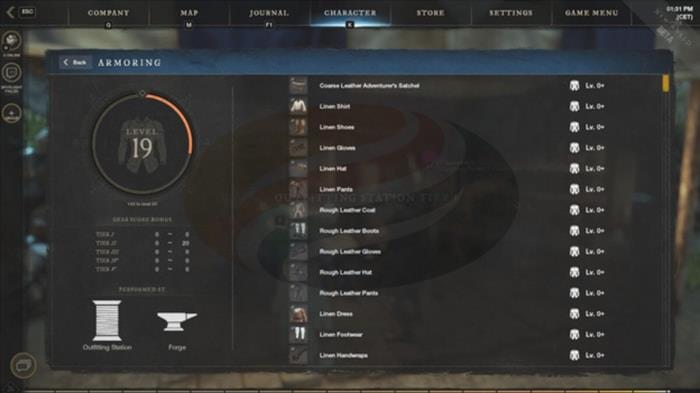
Progressive armoring advancement demands strategic resource accumulation across multiple tiers. Efficient material gathering requires understanding optimal sources and processing requirements for each essential component.
Cloth:
Cloth production begins with hemp fiber collection, requiring Harvesting skill level 25 for efficient acquisition. Once achieved, hemp plants become readily harvestable throughout Aeternum, with processed cloth creation available at any loom station.
Coarse Leather:
Rawhide refinement at leatherworking stations produces coarse leather. Wolves provide the most efficient rawhide source relative to combat time investment, making them the preferred farming target.
Iron Ingots:
Iron vein mining yields raw iron ore, requiring Mining skill level 25 for optimal collection. Smelting operations at furnace stations convert raw ore into usable iron ingots.
Sateen:
Advanced fabric creation combines cloth weave with linen, utilizing cross-weave obtained from world containers, supply crates, and various chests.
Alternative advanced weaves include wire weave and silk weave, both demanding master material converters and Tier 5 crafting components.
Silk:
Silk strand acquisition requires harvesting silkweed plants at Harvesting skill level 100, with subsequent refinement occurring at loom stations.
Linen Shirt:
Linen shirts provide excellent starting projects for armoring progression, offering balanced mobility with moderate protection levels.
These basic cloth armor pieces deliver equivalent crafting experience to other starter items while utilizing cloth, coarse leather, and iron ingots.
Sateen Pants:
Sateen leggings generate superior experience yields compared to linen shirts, requiring iron ingots, coarse leather, and sateen fabric.
Silk Gloves:
Silk glove construction utilizes iron ingots, coarse leather, and silk fabric for efficient leveling advancement.
Infused Silk Gloves:
Infused silk gloves become essential for reaching the maximum armoring level, requiring wire fiber, silk, and cross-weave components.
Progressive armoring mastery follows a structured path with distinct optimization strategies for each level bracket. Market fluctuations and server-specific economies may influence your approach, but these core principles remain consistently effective.
Level 0 – 50:
The initial phase emphasizes crafting diversity across items providing identical experience yields. Material efficiency becomes the primary consideration, with linen shirts offering optimal iron-to-fiber ratios.
Alternative options include coarse leather gloves or linen handwraps, both requiring four linen, four coarse leather, and one iron ingot per craft. Reaching level 50 requires approximately 11,995 total experience points.
Level 50 – 100:
Mid-tier progression introduces superior armor crafting with multiple advantages. Enhanced yield rates through weaving proficiency and high-tier cross-weave utilization allow more efficient sateen production from linen resources.
Resource optimization includes reduced secondary material consumption and potential recovery of advanced fabrics through salvaging operations.
Advancing from level 50 to 100 demands approximately 139,624 experience points. Sateen gloves or rugged leather gloves provide efficient leveling options using readily available iron, coarse leather, and linen components.
Level 100 – 150:
Silk clothing options unlock alongside sateen variants at level 100. Silk gloves represent the recommended crafting focus during this progression stage.
Tier 3 crafting locations become accessible for silk glove production. The level 100-150 journey requires approximately 986,580 experience points.
Level 150 – 200:
Maximum level achievement centers on infused silk glove production due to exceptional cost efficiency and low crafting taxation.
Reaching armoring level 200 demands approximately 5,046,300 experience points. Each infused silk glove craft yields roughly 6,075 experience points, making them the definitive choice for endgame progression.
Post-level 200 advancement continues through aptitude levels, with each level granting three reward boxes containing valuable materials and patterns.
The materials interface, positioned centrally within the crafting station screen, displays comprehensive resource requirements for each craftable item. Every armor piece demands at minimum one primary material and one secondary component for successful creation.
Strategic perk management enables predetermined first-perk selection through specific material additions. Azoth integration increases perk acquisition probabilities, though outcomes retain random elements with improved odds correlating to Azoth quantities invested.
Armor tier limitations establish Azoth capacity thresholds, requiring careful resource allocation decisions.
The Brimstone Sands expansion introduced transformative changes including doubled first-time craft bonuses. This adjustment particularly benefits armoring due to the extensive variety of craftable armor types available.
Town board assignments provide supplemental armoring experience for minimal resource investment. These tasks complement standard leveling procedures without replacing core crafting activities.
Expedition armor replicas from Genesis and Lazarus dungeons become craftable at level 160, offering exceptional experience-per-resource returns despite challenging material acquisition requirements.
Optimal salvaging techniques deliver additional armoring experience without requiring active crafting sessions.
Glove crafting consistently provides the most favorable experience-to-resource ratio throughout the leveling progression, making them consistently recommended for efficient advancement.
Strategic planning prevents common resource wastage and inefficient progression patterns. Many players underestimate the material requirements for advanced levels, leading to frustrating grinding sessions that could be avoided with proper preparation.
First-time craft bonuses represent the most significant leveling acceleration mechanism introduced in recent updates. Systematically crafting each armor type once during early levels can advance you to approximately level 50 without repetition.
Market monitoring for material price fluctuations can save substantial gold reserves. Server economies vary dramatically, making local market understanding crucial for cost-effective progression.
Avoid crafting higher-tier items prematurely, as they often consume disproportionate resources relative to experience gains at lower proficiency levels.
Expedition supply farming requires coordinated group efforts but delivers unmatched experience efficiency for players approaching the maximum level threshold.
For comprehensive gaming strategies beyond armoring, explore our Complete Guide covering comprehensive gameplay mechanics and strategic approaches.
Character build optimization through proper Class Guide that complements your armor selection decisions with optimal weapon and ability combinations.
Advanced players should consult our Weapons Unlock guide to ensure your combat capabilities match your protective gear investments.
Action Checklist
- Achieve Harvesting 25 for hemp, Mining 25 for iron, and skinning proficiency for rawhide collection
- Craft linen shirts exclusively from 0-50 for optimal resource efficiency
- Transition to sateen gloves from 50-100 for improved experience yields
- Focus on silk gloves from 100-150 for tier-appropriate advancement
- Mass produce infused silk gloves from 150-200 for maximum efficiency
- Complete town board armoring tasks daily for supplemental experience gains
No reproduction without permission:GameCDjnh » New World Armoring Leveling Guide Master New World armoring with expert strategies, resource optimization, and efficient leveling techniques