
TL;DR
- ESO features seven distinct crafting skill lines that can all be mastered on a single character
- Resource gathering is tier-based with ten levels, requiring strategic skill point allocation
- Crafting stations offer six core functions: refining, construction, deconstruction, improvement, research, and writs
- Always ensure 100% improvement success rate to avoid losing valuable materials
- Daily writs provide rare materials and consistent gold income for crafters
Crafting represents one of the most lucrative and essential systems in The Elder Scrolls Online. Developing your crafting expertise enables you to get rich in ESO by manufacturing high-value items that command premium prices in guild traders. However, the multiple crafting disciplines can overwhelm newcomers. Vress Games‘s instructional video provides foundational knowledge to navigate these complex systems effectively.
Crafting Skill Lines Overview
The Elder Scrolls Online presents seven distinct crafting professions, all developable on a single character without restriction. This unified approach eliminates the need for multiple crafting alts, streamlining your progression across all disciplines simultaneously.
Equipment Crafting Professions
The initial three professions constitute equipment manufacturing: Blacksmithing, Woodworking, and Clothier. Each specializes in producing and enhancing specific gear categories essential for adventuring.
Blacksmithing focuses on melee weaponry including swords, battle axes, and warhammers, alongside crafting heavy armor sets for maximum protection.
Woodworking crafts ranged weapons such as bows and destruction staves, while also manufacturing shields for defensive builds.
Clothier produces light and medium armor, catering to magicka and stamina builds respectively. Owners of the Summerset chapter gain access to Jewelry Crafting, enabling creation and enhancement of rings and necklaces with unique set bonuses.
These four equipment crafting professions share identical operational mechanics, which we’ll explore in detail. Additionally, three specialized crafting lines operate under different principles.
Specialized Crafting Skills
Alchemy enables potion creation from botanical specimens, fungi, and alchemical reagents discovered during exploration. Practitioners can experimentally combine ingredients to discover new elixir recipes through systematic testing.
Enchanting involves combining magical runes to produce glyphs that imbue weapons, armor, and jewelry with enhanced attributes and effects.
Provisioning covers culinary arts, creating food and drinks that provide temporary stat boosts. Additionally, all primary crafting lines enable furniture creation for player housing, though this constitutes an extension rather than independent skill line.
All seven crafting disciplines advance through inspiration experience, gained by performing profession-specific actions including manufacturing, dismantling equipment, and processing raw materials.
Now that you comprehend the item types craftable in ESO, the next critical phase involves resource acquisition throughout Tamriel. The primary collection method entails harvesting materials encountered while exploring diverse zones. You’ll frequently discover mineral deposits, lumber, flora, fungal growths, runestones, and numerous other collectible resources during your journeys.
Harvesting Raw Materials
To gather resources, simply approach and activate them using the “E” key. No special prerequisites govern harvesting beyond character level progression. As you achieve higher levels, superior-tier resources manifest throughout the game world.
Skill Point Optimization
Enhancing collection efficiency requires strategic skill point investment. For instance, the Blacksmithing skill tree offers Keen Eye, highlighting ore deposits visually, and Miner Hireling, which automatically delivers raw materials daily.
Resource quality follows a tiered hierarchy with ten distinct grades per material type. In Blacksmithing, progression advances from iron ore through steel ore ultimately reaching Rubedite ore at maximum tier.
Container exploration represents another acquisition method, with sacks, barrels, and crates potentially containing crafting components. Exercise caution when container text appears crimson—this indicates theft, potentially resulting in guard intervention and bounty imposition.
Equipment deconstruction at crafting stations provides the final resource procurement avenue, which we’ll examine subsequently.
Inventory Management Solutions
During your adventures, comprehensive resource collection proves advantageous. This highlights the primary constraint for non-subscribers—the Crafting Bag. Without this bottomless repository, inventory management becomes a persistent challenge. While alternative storage expansion methods exist, none match the convenience of the ESO Plus crafting inventory. Evaluate whether subscription costs outweigh time expenditures on organizational tasks.
With accumulated resources, you’re prepared to transform them into Tamriel’s finest equipment through systematic crafting processes.
Your first action involves locating crafting stations, readily available in most major settlements. Each profession features dedicated stations offering distinct functional options. Since Blacksmithing, Woodworking, Clothier, and Jewelry Crafting share operational principles, we’ll utilize Blacksmithing as our exemplar.
Refining Process
The four equipment crafting disciplines present six functional tabs at stations. Initial processing involves refining collected raw materials into usable crafting components. The ten resource tiers convert into ten material grades for manufacturing. Superior materials enable creation of higher-level Elder Scrolls Online items with enhanced attributes.
Construction Techniques
The subsequent tab facilitates equipment creation. Blacksmithing options encompass melee weapons and heavy armor production. You can adjust crafted equipment level, with elevated tiers demanding increased material investment.
Style selection determines visual appearance, while trait assignment confers specific properties or effects. In this instance, I’m manufacturing armor utilizing Breton aesthetics. Alternative materials could produce identical statistical gear with different visual presentation.
The third tab enables deconstruction. During questing and dungeon exploration, you’ll acquire numerous unwanted items. Dismantling equipment yields materials, improvement components (tempers, tannins, resins), alongside style and trait materials for research purposes.
Improvement Systems
Improvement components then serve in the fourth tab to enhance item quality within your inventory—this applies to any equipment, not necessarily self-crafted items.
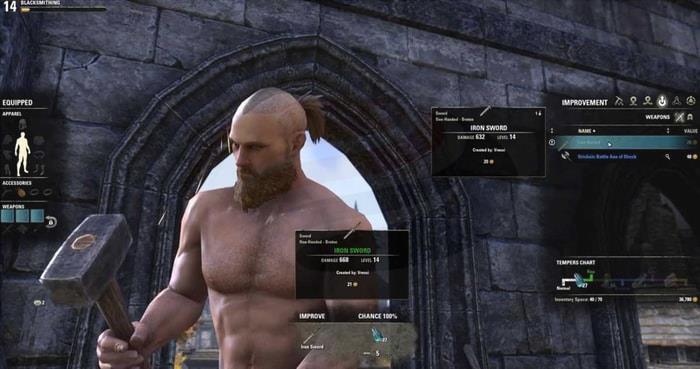
The interface displays percentage success probability based on material quantity allocated for improvement. As you advance in skill line proficiency, fewer materials achieve 100% success rates. Always guarantee maximum success probability—failure at 80% results in complete loss of both resources and the item, representing a devastating setback for crafters.
Research System
The fifth tab, Research, often proves most perplexing for newcomers. This system enables trait application to crafted items. Examples include enhanced regeneration of Stamina, Health, or Magicka, among numerous other beneficial properties.
To apply traits to weapons, locate equipment possessing desired characteristics and initiate research. Research consumes the item permanently, so exercise discretion when selecting research candidates.
Research durations span hours typically, though acceleration items reduce timers, and progression continues during logout periods. Upon completing research and acquiring necessary components, you can incorporate that trait into subsequently crafted weaponry.

Alchemy Mastery
Alchemy
Potion creation occurs at Alchemy stations utilizing solvents and reagents discovered during expeditions. To unveil new potion varieties, experimentation becomes necessary unless consulting external resources.
Formulas require one solvent combined with two reagents. Initial attempts generate messages indicating either non-reactive combinations or successful creation with unidentified effects. Avoid non-reactive mixtures, focusing instead on combinations producing unknown effects.
Successful potion brewing reveals reagent properties, enabling precise formulation in subsequent creations rather than speculative attempts. Additionally, Alchemy stations enable poison manufacturing, functioning similarly but producing consumables that enhance combat capabilities when equipped.
Enchanting Techniques
Enchanting
Rune combination produces glyphs that confer additional properties to weapons, armor, and jewelry. Diverse combinations yield varying results. Through systematic experimentation, you’ll uncover runic properties, facilitating specialized glyph creation.
Rune extraction represents the secondary Enchanting station function, equivalent to equipment deconstruction. Glyph destruction yields constituent runes for subsequent enchantment projects.
The seventh and final station covers Provisioning, representing the most straightforward discipline. Utilize recipes discovered during adventures by learning them through double-clicking or inventory activation, then combine ingredients and execute creation.
Writs Certification
Writs
One crucial additional element involves crafting Writs—daily profession quests offering substantial value through rare material rewards. Certification requires completing several straightforward introductory quests rapidly accomplished.
Millenith resides within Fighters Guild halls, providing Blacksmithing, Clothing, and Woodworking certification quests. Danel Telleno occupies Mages Guild locations, offering Enchanting, Alchemy, and Provisioning certification. Jewelry Crafting requires Summerset chapter ownership and consultation with Felarian in Alinor.
These brief missions require mere minutes completion. Upon finishing, you become certified in that crafting discipline, enabling daily Writ completion.
Daily Writ acquisition requires visiting Equipment Crafting Writ boards, conveniently located near crafting stations in faction capitals.
To collect these quests daily, locate Writ noticeboards in your faction’s primary city, typically adjacent to crafting stations for convenience.
I trust this comprehensive guide proves beneficial for your crafting journey. If this Elder Scrolls Online beginner Crafting manual assists your progression, please share it with companions and allies throughout Tamriel. For those seeking alternative progression paths, ESO gold for sale available through MmoGah, utilizing secure delivery methods ensuring prompt, smooth transactions. Additionally, bookmark our ESO news portal for forthcoming guides and updates.
For comprehensive gameplay strategies, consult our Complete Guide to master all aspects of your adventure. Weapon enthusiasts should explore our comprehensive Weapons Unlock guide for armament mastery. Character development specialists will find our Class Guide essential for optimizing build performance across various content types.
Action Checklist
- Complete all crafting certification quests to unlock daily writs
- Allocate skill points to Keen Eye and Hireling passives for each crafting line
- Establish daily resource gathering routes through high-density zones
- Begin trait research immediately—this process takes weeks to complete
- Always ensure 100% improvement success rate before attempting upgrades
- Systematically deconstruct all non-researchable equipment for materials
No reproduction without permission:GameCDjnh » ESO Crafting Guide for Beginners Master ESO crafting from raw materials to profitable gear with expert strategies and optimization tips