
Behind the world’s first drone-powered Tetris championship: technical innovation and player insights
The Drone Technology Breakthrough
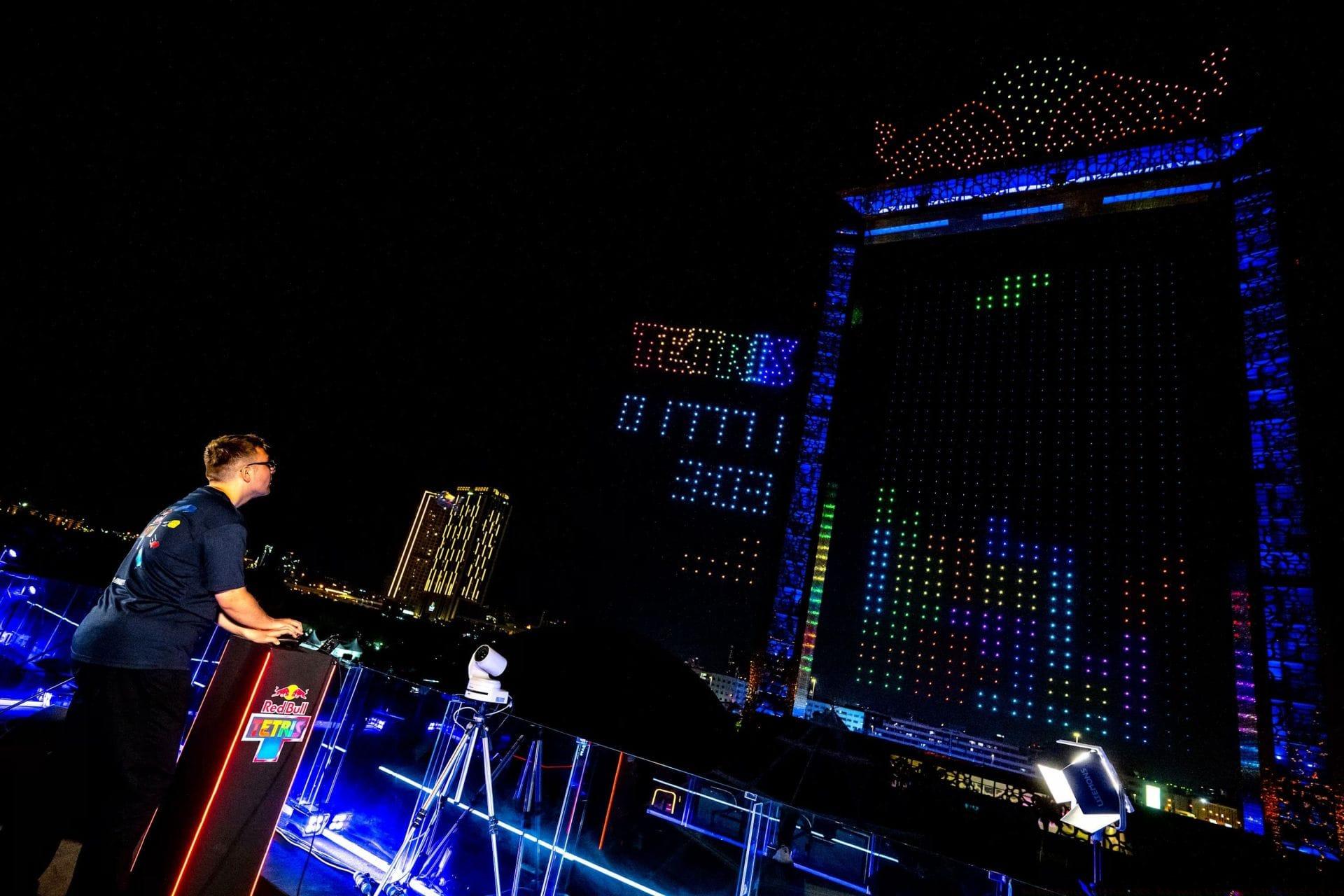
The Red Bull Tetris World Final 2025 delivered an unprecedented fusion of gaming and aerial technology that exceeded all expectations. While the spectacular centerpiece featured approximately 1,400 synchronized drones forming a playable screen within Dubai’s iconic 150-meter Frame structure, the entire production meticulously honored Tetris’s complete legacy—from its historical origins to contemporary competitive scenes and future innovations.
December 13 provided ideal conditions for the groundbreaking spectacle, with weather cooperating perfectly for the massive drone deployment. The technological marvel utilized 4,000 drones in total—1,200 reserved for the opening sequence and 2,800 allocated for gameplay, divided equally between two separate flights of 1,400 drones each.
Custom Drone Development and Technical Hurdles
I engaged in a pre-event discussion with Kris Vloemans, the Project Director responsible for orchestrating this technological marvel, to understand the development process.
Q: What unique advantages does drone technology bring to esports visual presentation?
Kris: The primary benefit involves enhanced visibility—we’re collectively striving to elevate esports exposure. This collaboration with Red Bull transcends being merely another tournament. The immersive quality you’ll witness tonight represents the core differentiator.
Q: Could you elaborate on the creative process behind developing this live-playable match—the inspiration and underlying motivation?
Kris: It began with an unconventional concept and a team willing to pursue seemingly impossible ideas. This achievement marks a global premiere—something previously unaccomplished. Standard drones lack live gameplay capabilities. Development commenced early last year, requiring completely customized hardware solutions.
The professional players’ incredible speed presented significant challenges regarding latency management, frame rate optimization, and player satisfaction metrics. Yesterday we conducted a test session with Henk Rogers that produced astonishing results. After five minutes of gameplay on the drone screen, he inspected the 4,000 drones in the rear parking area and expressed genuine amazement, having previously raised identical technical concerns.
Angshuman: Earning Henk’s admiration constitutes a substantial accomplishment.
Kris: Absolutely. That recognition represents our highest possible achievement and most meaningful compliment.
Safety Protocols and Future Drone Applications
Q: Describe the event preparation process, particularly regarding synchronization, safety measures, and contingency planning for potential failures.
Kris: We implemented extensive safety protocols because numerous complications can arise when operating thousands of individual aerial pixels. Fundamentally, this remains a drone light show subject to all standard aviation regulations—safety zones, crowd protection, vehicle restrictions. We analyzed worst-case scenarios including trajectory paths if drones experienced failure.
Strategic stage positioning ensures that technical malfunctions or sudden weather changes won’t compromise the show’s integrity or endanger participants.
Q: Considering your innovative approach, what ambitious drone concept would you pursue for future esports events?
Kris: Imagine drivers experiencing massive drive-through cinemas with gigantic pixel screens displaying live sports content. The technology could transform any arena into an enormous display. That advancement would represent the next evolutionary stage—deployable virtually anywhere.
Q: Explain how these custom drones were modified for this specific event and the development challenges encountered.
Kris: The fundamental obstacle involved real-time gameplay compatibility. Standard drones lack this capability. We confronted latency issues, frame rate optimization, and custom software development. Although you see a secondary monitor, each pixel functions wirelessly, requiring ultra-rapid data transmission.
We overcame numerous technical barriers through close collaboration with Tetris developers, who co-developed and validated the specialized coding. Until recently, we hadn’t implemented sound effects because success remained uncertain. Only after comprehensive testing confirmed viability did we incorporate audio elements.
Champion Fehmi Atalar’s Winning Strategy
The championship commenced with an elaborate opening ceremony featuring the Firdaus Orchestra and spectacular fireworks cascading from Dubai Frame’s summit. This distinctive structure, resembling an enormous picture frame, towers at 150.24 meters with a 95.53-meter width. The drone fleet illuminated the interior space with vibrant Red Bull and Tetris branding.
During the Grand Finals, both competitors received five-minute rounds to achieve their highest scores, with the top performer claiming the championship. The evening initiated with a preliminary match determining play order. Atalar strategically selected the second position, ultimately securing victory with apparent ease. Following his triumph, I discussed his experience and approach.
Q: Describe your preparation, performance, and victory experience in this unprecedented drone-based Tetris tournament.
Fehmi: I engaged in extensive repetitive practice to anticipate potential outcomes. Initially qualifying using a friend’s mobile device, for which I’m grateful. During the National Finals, I trained extensively on PC versions and achieved dominance. For the drone competition, I experimented with an innovative grip technique that proved exceptionally effective. My performance demonstrated machine-like precision.
Q: From my observation, your final performance appeared flawless. Do you share this perspective, or do you identify areas for potential improvement?
Fehmi: Not necessarily better execution but cleaner technique. Indeed, I completed the final without conceding any points, which represents a notable accomplishment.
Drone Gameplay Challenges and Strategic Insights
Q: What specific challenges did drone technology introduce to gameplay?
Fehmi: The drones presented several complications, including approximately 20ms micro-input delays. Maintaining skyward vision for five-minute intervals significantly strains neck muscles. However, I’ve developed adaptation techniques. The unique platform also introduced psychological pressure affecting both competitors.
Q: Did the second position provide strategic advantages?
Fehmi: I chose the second slot because my opponent would initially experience and analyze the game mechanics. The subsequent player can devise strategic approaches, which I executed precisely. Ultimately, I focused predominantly on Tetris line clears to demonstrate superiority during the concluding segment.
Q: What originally sparked your Tetris interest?
Fehmi: My aunt inspired me. Back in 2013, I observed her playing Tetris on a CRT television, which ignited my fascination.
Q: What guidance would you offer aspiring players seeking improvement?
Fehmi: Younger players possess significant advancement potential. When playing Tetris, embrace losing experiences as learning opportunities. Most importantly, maintain enjoyment—if you’re not having fun, experiment with different approaches because psychological engagement is essential for improvement.
Q: Who served as your competitive inspiration during your early Tetris career?
Fehmi: I hadn’t established favorite players until recently. Currently, I admire Doremy for modern Tetris and Jonas Neubauer for classic variations.
Tetris Legacy and Event Experience
My introductory comments addressed Red Bull’s challenge balancing visual spectacle, celebratory atmosphere, and Tetris’s distinctive identity for diverse audience engagement. As Rogers emphasized during our conversation, every Tetris iteration must preserve the original game’s essence. This principle applies equally to this innovative event format.
Every venue location incorporated the iconic Tetris pentominoes throughout the environment. Red Bull provided multiple interactive gaming stations, including specialized Red Bull cans containing playable Tetris versions. Commentators like Mykal Buster enhanced the event’s credibility. The participation of Alexey Pajitnov, Henk Rogers, and other Tetris Company representatives reinforced this comprehensive Tetris celebration.
Simultaneously, Red Bull maintained its characteristic energetic, festive atmosphere synonymous with their events. Whether through the exotic Terra Solis retreat ambiance or the breathtaking Dubai Frame drone demonstration, organizers successfully translated Tetris gameplay into multiple immersive audience experiences.
My sole criticism involves the Grand Finals’ limited Tetris action duration. Would a best-of-five format have resolved this concern? Potentially. However, I suspect organizers weighed audience engagement sustainability against operational complexities of extended outdoor drone performances.
Regardless, the Red Bull Tetris World Final 2025 unquestionably succeeded while perfectly capturing Tetris’s spirit: honoring the game’s creators, celebrating current enthusiasm, and supporting future competitive development. If Red Bull plans subsequent Tetris World Finals, their approach to surpassing this achievement will prove fascinating to observe.
Practical Insights for Aspiring Competitive Players
For players inspired by this technological marvel seeking to improve their Tetris skills, several practical approaches can accelerate development. Master the fundamental Tetris opening—the DT Cannon opener provides consistent piece efficiency and scoring potential. Practice recognizing T-Spin opportunities, as these advanced maneuvers separate intermediate from expert players.
Common beginner mistakes include over-focusing on Tetris line clears while neglecting smaller combinations, poor piece preview utilization, and inadequate garbage hole management. Develop the habit of scanning multiple pieces ahead rather than reacting to immediate placements.
Advanced optimization involves learning specific opener transitions, understanding garbage blocking strategies, and developing consistent stacking patterns. For drone or large-screen adaptations, practice maintaining visual focus on distant displays and adapt to minimal input latency through anticipatory movements.
Professional players recommend daily focused practice sessions rather than marathon gaming, utilizing replay analysis to identify pattern weaknesses, and participating in online tournaments to gain competitive experience under pressure conditions.
No reproduction without permission:GameCDjnh » Red Bull Tetris World Final 2025: Made gaming history one falling block at a time Behind the world's first drone-powered Tetris championship: technical innovation and player insights