
Comprehensive guide to building efficient Minecraft railway systems with expert crafting tips and optimization strategies
Why Build Railways in Minecraft
Minecraft railway networks revolutionize long-distance travel, enabling swift movement across vast landscapes that would otherwise require extensive walking or building. While constructing your personalized rail system demands initial time investment, the long-term benefits of rapid transit and automated transport make it exceptionally worthwhile for any serious Minecraft player.
As an open-world sandbox experience, Minecraft empowers creators with unparalleled freedom to design and build complex transportation infrastructure using simple block placement mechanics. Success in railway construction hinges on selecting appropriate materials and applying strategic creativity to overcome terrain challenges and optimize travel routes.
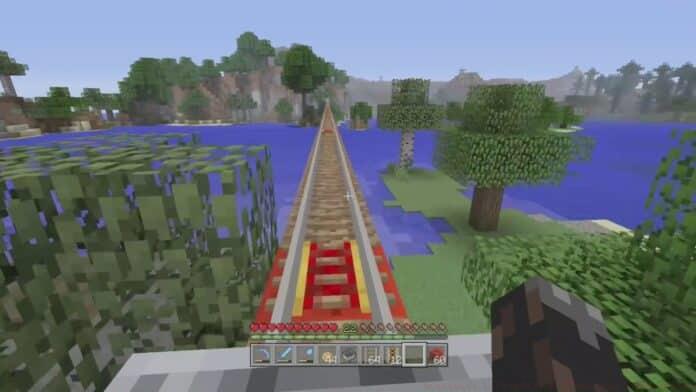
Essential Materials and Crafting Recipes
Successful railway construction begins with understanding the core components and their specific functions within your transportation network.
- Crafting Formulas
- Basic Rail Construction – Combine 6 iron ingots and 1 stick in the crafting grid. Position iron ingots to leave only the middle column empty (slots 2, 5, and 8), then place the stick precisely in the center position (slot 5). This yields 16 rail segments per crafting operation.
- Powered Rail Creation – Requires 6 gold ingots, 1 stick, and 1 Redstone dust. Arrange materials identically to basic rail placement, with the crucial addition of Redstone in the bottom-center position (slot 8). This creates 6 powered rail segments that will accelerate minecarts when activated.
- Assembly Instructions
- Position 5 iron ingots on the crafting table to fill all positions except the top-middle slot (position 2) and ensure the second row (slots 4, 5, 6) is completely filled, leaving the bottom row entirely empty.
- Fabrication Process
- Combine 1 stick placed in the top-center position (slot 2) with 1 Redstone dust positioned directly beneath it in the middle row center (slot 5).
Material quantities scale according to your intended track length, but maintaining the optimal 5:1:1 ratio (5 basic rails : 1 powered rail : 1 Redstone torch) ensures efficient resource utilization and consistent travel speed throughout your railway network.
Step-by-Step Railway Construction
Now we reach the practical implementation phase—transforming raw materials into a functional transportation system through methodical construction techniques.
Congratulations! You’ve now established a fully operational railway system ready for immediate use. This infrastructure provides reliable transportation that can be expanded or modified as your Minecraft world evolves.
Advanced Optimization Strategies
Beyond basic construction, several expert techniques can significantly enhance your railway’s performance, reliability, and resource efficiency.
Speed Optimization Techniques: For maximum velocity, consider reducing powered rail spacing to every 3-4 basic rails on uphill sections, as incline travel demands more propulsion. On downhill segments, you can extend spacing to 7-8 basic rails between powered units since gravity provides natural acceleration. Always place powered rails on flat surfaces before slopes to build momentum.
Common Construction Mistakes: Beginners often misplace Redstone torches too far from powered rails—they must be adjacent to function. Another frequent error involves improper rail alignment at junctions, causing minecarts to derail. Always test each section thoroughly before expanding your network. Avoid building tracks near hostile mob spawning areas without adequate lighting protection.
Efficiency Improvements: Create automated loading and unloading stations using detector rails and hopper systems. Implement switching stations for multi-destination networks. For long-distance travel, build underground tunnels to protect against environmental damage and mob interference. Consider using named minecarts with chests for organized item transport systems.
Recommended | Netflix Forays into Mobile Gaming
No reproduction without permission:GameCDjnh » How To Make Your Very Own Railway System in Minecraft? Comprehensive guide to building efficient Minecraft railway systems with expert crafting tips and optimization strategies