
TL;DR
- Master the 5-poke rule: fish always bite on the fifth poke if they haven’t already
- Learn shadow analysis to identify fish types before catching them
- Use fish bait strategically to spawn specific fish types
- Understand tail swerve patterns to distinguish between size categories
- Optimize your timing by focusing on audio cues rather than visual indicators
Fishing represents one of the most engaging activities in ACNH, offering both relaxation and substantial Bells Animal Crossing currency rewards. Many newcomers experience frustration when fish repeatedly escape their hooks, but with proper technique, you can dramatically improve your success rate. This comprehensive guide synthesizes expertise from GosuNoob, ConCon, and Minipa to transform you into a fishing expert in Animal Crossing: New Horizons.
Acquiring Your Fishing Equipment
Your fishing journey begins with crafting your first rod. After establishing your tent and conversing with Tom Nook, he provides a complimentary DIY tutorial demonstrating how to create a Flimsy Fishing Rod at his workbench. The recipe requires 5 Tree Branches, which you can collect from the ground beneath trees or by vigorously shaking trees until they drop. Many players overlook that shaking trees multiple times often yields additional branches beyond the initial drop.
To successfully catch fish, you must first identify dark shadows moving through water bodies—whether ponds, rivers, or ocean areas. Position yourself along the shoreline facing the fish, then press the “A” button to cast your line. The critical placement involves dropping the lure directly in front of the fish’s path. Casting too distant from the target will fail to capture its interest, requiring recasting.
Fish will investigate your bait with one to four preliminary nibbles before committing to a full bite. The decisive moment occurs when the fishing rod’s bobber completely submerges accompanied by a distinctive “plop” sound—this signals the exact instant to rapidly press “A” for a successful catch. Remember this crucial pattern: if a fish investigates your lure four times without biting, it will invariably bite on the fifth interaction. Visual demonstrations from GosuNoob and ConCon clearly illustrate the precise timing for button pressing.
You can enhance your fishing efficiency by crafting Fish Bait after digging up Manila Clams from beach areas marked by water spouts. When fish appear scarce in your preferred fishing locations, scattering bait immediately summons one fish to the spot. This technique proves particularly valuable when hunting specific rare fish that only spawn in particular locations or during specific weather conditions.
The most sophisticated time-saving technique involves Shadow Analysis mastery. By observing fish shadows before casting, you can identify potential catches using Minipa’s systematic approach:
Larger Shadows Exhibit Slower Tail Movements
When fish remain stationary in their idle position, their shadow behaviors reveal size distinctions through tail movement patterns. Smaller shadows demonstrate significantly faster tail swerving frequencies compared to larger specimens. Shadows categorized as sizes 1-3 represent progressively enlarged versions with no dramatic morphological differences beyond dimensional scaling. The key distinguishing feature involves progressively decreasing tail swerve frequency as shadow size increases. Upon reaching size 4 shadows, you’ll observe increased tail angle amplitude, creating whip-like motions rather than the bounce-like movements characteristic of smaller sizes.
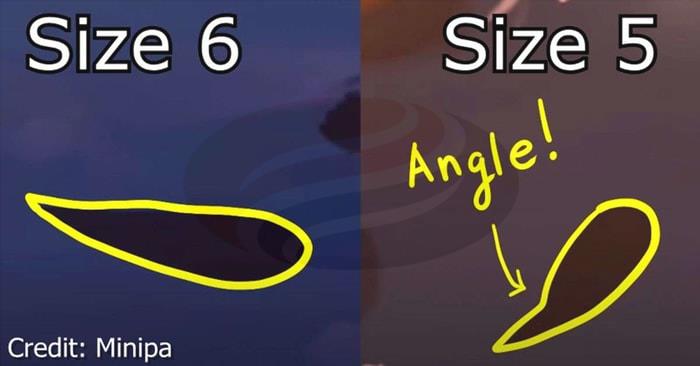
Despite sharing similar silhouettes, sizes 1-5 maintain comparable body shapes featuring prominent top-heavy heads that taper dramatically toward the tail section. Size 6 shadows differ fundamentally from all other categories through multiple characteristics: increased dimensions, altered body morphology, and substantially reduced movement frequency. While size 5 fish retain the whip-like tail motions of size 4 and the top-heavy profile of smaller varieties, size 6 specimens display rounder head shapes compared to size 5. The largest category exhibits thicker, elongated bodies with more evenly distributed girth and gradual rather than abrupt tail tapering.
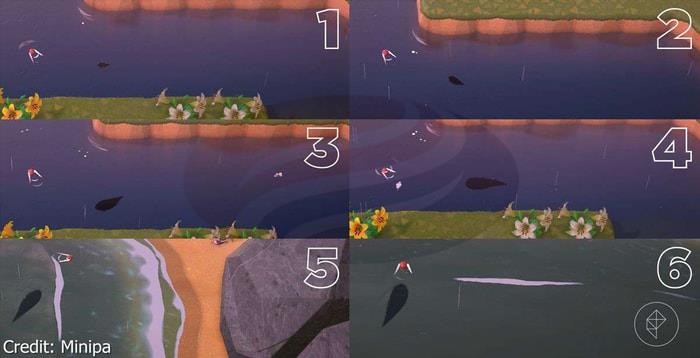
Seasoned anglers develop refined techniques that significantly boost their catch rates and efficiency. One common mistake involves reacting to visual cues alone—successful fishers learn to prioritize the audio “plop” signal, which provides a more reliable timing indicator than the bobber animation. Practice in controlled environments like your island’s rivers before attempting ocean fishing, where wave movements can distract from crucial visual cues.
Advanced shadow analysis enables you to selectively target valuable fish while ignoring common varieties, saving both time and fishing rod durability. By recognizing that size 6 shadows (which include rare species like whale sharks and ocean sunfish) exhibit completely different body proportions and movement rhythms, you can focus your efforts on high-value targets. This selective approach becomes particularly important during fishing tournaments where efficiency determines victory.
Optimize your fishing sessions by understanding spawn mechanics—fish appear more frequently during rain, and certain species only emerge during specific months or times of day. For comprehensive gameplay strategies beyond fishing, consult our Complete Guide to master all aspects of island life.
Upgrade your fishing rod as soon as possible—the standard and golden fishing rods provide significantly improved durability, reducing how frequently you need to craft replacements. The flimsy fishing rod breaks after approximately 10-15 uses, while standard rods last 25-30 catches. This durability knowledge helps plan your fishing expeditions more effectively.
Mastering the relationship between shadow size and fish value allows strategic decision-making—prioritize larger shadows during limited fishing sessions. For weapon customization approaches similar to fishing optimization, explore our Weapons Unlock strategies for systematic progression.
Action Checklist
- Craft flimsy fishing rod using 5 tree branches from shaking trees or ground collection
- Practice casting to land lures directly in front of fish shadows
- Master the 5-poke rule and audio cue timing
- Learn shadow size identification through tail movement patterns
- Craft and use fish bait strategically for rare species hunting
No reproduction without permission:GameCDjnh » How to Fish in Animal Crossing: New Horizons Master fishing mechanics, shadow analysis, and advanced techniques to maximize your catch in Animal Crossing: New Horizons