
TL;DR
- Beast Mastery Hunter and Destruction Warlock dominate TBC DPS rankings throughout all phases
- Restoration Shaman provides unmatched raid utility with powerful totem buffs and multi-target healing capabilities
- Class viability significantly improves compared to Classic WoW, with most specs becoming raid-viable
- Proper raid composition requires strategic class stacking for maximum damage output
- Gearing efficiency and talent optimization are crucial for competitive performance
The transition from Classic WoW to WoW Classic TBC dramatically reshapes class viability, with nearly every specialization becoming competitive in raid environments. Unlike the previous iteration where Warriors dominated, TBC introduces balanced class distribution with multiple viable damage-dealing options.
Current DPS Rankings for classic TBC reveal a diverse meta where strategic class selection becomes paramount for raid success. These performance metrics are continuously updated as TBC Classic progresses through its various content phases.
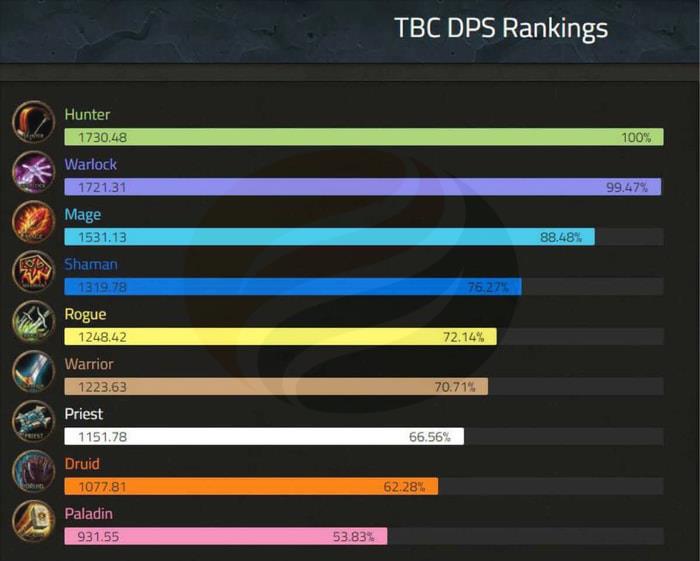
Hunter, Warlock, Mage, and Shaman represent the elite tier in TBC damage output. Beast Mastery Hunter and Destruction Warlock deliver exceptional sustained damage, while Restoration Shaman offers unparalleled healing efficiency and raid-wide utility through totem management.
Top-tier guilds will strategically stack these dominant classes to maximize raid damage potential, mirroring the previous Warrior stacking strategy from Classic WoW.
Hunter
Hunters emerge as the premier damage dealers in TBC Classic, with Beast Mastery Hunter establishing itself as arguably the strongest DPS specialization throughout the entire expansion lifecycle.

The Survival Hunter specialization offers remarkable flexibility for players seeking alternative playstyles. Talent allocation can be customized based on individual crit requirements, with options to redistribute points between Master Tactician and trap-enhancing talents according to personal preference and gear progression.
Warlock
Warlocks secure their position as the secondary powerhouse class, demonstrating exceptional performance in both single-target encounters and AoE situations across all TBC content.
Raid leaders frequently stack multiple Warlocks due to their exceptional scaling with minimal gear investment requirements.
Affliction Spec represents the optimal starting point for Warlocks entering raid content. The specialization provides substantial hit rating through Suppression talent while delivering three crucial raid buffs: Blood Pact for health increases, Shadow Embrace for damage reduction, and Malediction for spell vulnerability enhancement.

Mage
Fire Mage establishes a solid position within tier 4 rankings. Players typically transition to this specialization once they acquire sufficient critical strike gear to reliably trigger Ignite procs for substantial damage amplification.
The Ignite mechanic synergizes powerfully with  Meteor when Mages talent into this advanced spell capability.
Players entering TBC with tier 3 gear from Classic will benefit from enhanced hit chance and critical strike probabilities.
Arcane Spec presents an intriguing alternative for Mages seeking burst damage potential, though it demands careful mana management throughout extended encounters.
Shaman
Restoration Shaman demonstrates exceptional healing versatility across all encounter types. Their passive abilities significantly reduce casting time and mana expenditure while simultaneously enhancing healing effectiveness.
Shaman utility extends beyond pure healing, providing crucial mana regeneration through  Mana Tide Totem deployment, complemented by powerful multi-target healing via
  Chain Heal and
  Healing Rain mechanics.
Signature Restoration abilities include  Earth Shield,
  Riptide, providing sustained buffs, instant cast healing responses, and healing-over-time effects.
Elemental Shaman occupies a comfortable position within tier A rankings as utility-focused damage dealers.
Rogue
Achieving raid success as a Rogue requires meticulous attention to several critical DPS optimization principles.
1. Maintain survival priority above all damage considerations
2. Avoid actions that potentially jeopardize raid stability
3. Optimize positioning to maximize time dealing damage
4. Manage energy resources efficiently to prevent capping
5. Utilize specialized spreadsheets to determine optimal ability rotation sequences
6. Strategically deploy cooldowns for maximum impact during critical encounter phases
Warrior
Warrior performance exhibits dynamic tier movement based on game phase progression and content clearance status.
As Warriors progressively acquire superior gear throughout TBC’s lifecycle, their damage output escalates significantly, making them viable starting options for the expansion.
Priest
Priests offer dual-role flexibility, enabling players to specialize in healing as Holy Priests or transition to damage dealing as Shadow Priests.
Shadow Priest secures a respectable position within tier B rankings. While not topping DPS meters individually, they provide indispensable raid support through mana regeneration and damage amplification mechanics.
Druid
Feral Druid occupies a comfortable tier position while delivering substantial map control and tactical advantages for raid compositions.
Paladin
Retribution Paladin receives significant quality-of-life improvements in TBC compared to Classic WoW.
The introduction of Crusader Strike represents the most impactful enhancement for Retribution Paladins, elevating their competitive standing among other damage-dealing specializations.
Strategic class stacking remains essential for maximizing raid damage output in TBC Classic. Top-performing guilds will typically include multiple Hunters and Warlocks while ensuring adequate Restoration Shaman representation for optimal buff coverage and healing efficiency.
Common optimization pitfalls include improper talent distribution, suboptimal cooldown utilization, and failure to adapt rotation strategies based on encounter mechanics and phase transitions.
Advanced players should focus on phase-specific gearing strategies, understanding that class performance rankings evolve as new tier sets and raid content become available throughout the expansion’s lifecycle.
For comprehensive TBC preparation strategies, consult our detailed Complete Guide covering all aspects of class preparation and raid readiness.
Understanding class synergy and proper raid composition is crucial for success in TBC’s challenging endgame content. Proper execution of these optimization principles typically requires 15-25 hours of focused practice to master advanced rotation techniques and encounter-specific adaptations.
If you’re preparing for TBC Classic launch, our Weapons Unlock guide provides essential information for gearing your chosen specialization efficiently.
For additional class selection guidance and specialization comparisons, explore our comprehensive Class Guide resources for detailed analysis of each class’s strengths and limitations.
Action Checklist
- Analyze current DPS tier rankings and identify 2-3 target specializations based on your playstyle preferences and raid goals
- Research optimal talent builds for your chosen class using community-vetted resources
- Practice core rotation mechanics on training dummies for 2-3 hours to build muscle memory
- Study encounter-specific adaptations for your specialization in upcoming raid content
- Join class-specific Discord communities to access advanced optimization spreadsheets and theorycrafting resources
- Coordinate with raid leaders to understand optimal class stacking strategies for your guild’s composition
No reproduction without permission:GameCDjnh » Guide to Best DPS Classes in WoW Classic TBC Master TBC Classic DPS rankings with expert class analysis, optimization strategies, and raid performance insights