
TL;DR
- Spirit Sword provides +2 skills, 35% faster cast rate, and massive mana boost for early game dominance
- Crystal Swords from Normal Cow Level (ilvl 26-41) guarantee 4 sockets via Larzuk quest
- Rune order: Tal + Thul + Ort + Amn in 4-socket sword for successful crafting
- Normal Countess drops Tal runes, Nightmare/Hell Countess provides Thul and Amn runes
- Cube recipe offers 50% chance for 4 sockets but requires specific components
The Spirit Sword stands as one of the most powerful early-game runewords in Diablo 2 Resurrected, offering exceptional value for spellcasting classes. Many players underestimate its potential impact during the leveling process, making this comprehensive guide essential for maximizing your character’s progression efficiency.
Spirit Sword Stat Breakdown
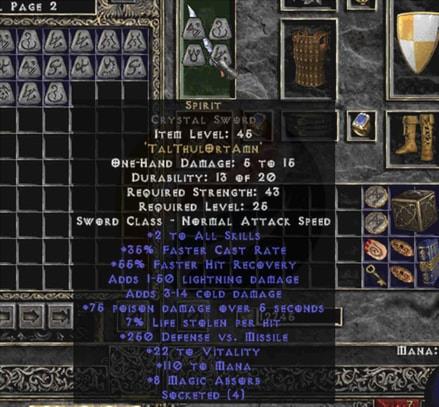
This exceptional runeword delivers game-changing bonuses that significantly accelerate your early to mid-game progression:
- +2 to all skills – dramatically boosts spell damage and utility abilities
- +22 to Vitality – provides substantial life increase for survivability
- +25-35% Faster Cast Rate – crucial for spellcasting fluidity and DPS
- +250 Defense vs Missiles – reduces ranged damage from archers and casters
- +3-8 Magic Absorb – provides additional protection against magical attacks
- +55% Faster Hit Recovery – prevents stun-locking from rapid enemy attacks
- +75 Poison Damage over 5 seconds – adds supplemental damage over time
- +89-112 to Mana – eliminates mana management issues for most builds
- 7% Life Stolen Per Hit – provides sustainability through life leech
- Adds 1-50 Lightning Damage – contributes to overall damage output
- Adds 3-14 Cold Damage for 3 Seconds
Crafting Requirements Overview
Successful Spirit Sword creation demands precise preparation of five critical components. The rune sequence must be executed flawlessly to avoid wasting valuable materials.
You’ll need: A four-socket sword base, Tal Rune, Thul Rune, Ort Rune, and Amn Rune. The insertion order is non-negotiable – Tal first, followed by Thul, then Ort, and finally Amn. This specific sequence activates the runeword’s full potential.
Base sword selection proves critical for accessibility. Crystal Swords emerge as the optimal choice due to their minimal dexterity requirements, allowing most character builds to equip them immediately. Long Swords and Broad Swords serve as viable alternatives but may demand higher attribute investments.
Pro tip: Always verify your sword has exactly four sockets before beginning the rune insertion process. Attempting this with fewer sockets permanently wastes your runes.
Socket Acquisition Strategies
Finding naturally occurring four-socket swords proves exceptionally rare in early gameplay. Two primary methods exist for obtaining your base weapon, each with distinct advantages and considerations.
- Larzuk Socketing Method
Larzuk’s quest reward represents the most reliable approach. This Act V quest completion bonus guarantees the maximum possible sockets based on your weapon’s item level (ilvl).
Critical understanding: Item level directly determines socket outcomes. Since ilvl remains invisible, you must control where your base items originate. Crystal Swords with ilvl between 26-41 consistently receive four sockets through Larzuk’s service.
The Normal difficulty Secret Cow Level stands as the premier farming location for Crystal Swords within this ilvl range. White (normal) quality swords dropped here, when presented to Larzuk, will reliably become four-socket weapons. This method works identically for Broad Swords and Long Swords.
- Cube Recipe Alternative
The Horadric Cube offers a secondary method with inherent randomness. The socket recipe requires: 1 Ral Rune, 1 Amn Rune, 1 Perfect Amethyst, and a normal Crystal Sword (or Broad/Long Sword variant).
Important caveat: This approach provides only a 50% probability of achieving four sockets. The outcome distribution includes possibilities for 1-6 sockets, making it significantly less consistent than Larzuk’s guaranteed method.
Strategic Rune Collection
Efficient rune acquisition demands targeted farming approaches. Each required rune has optimal sources that minimize time investment while maximizing success rates.
- Primary Rune Sources
Tal Runes primarily drop from Normal difficulty Countess runs. This Act I boss represents your most consistent source, with additional Tal runes available as rewards from completing the Act V quest line, which also provides Ort Runes.
Advanced strategy: The Nightmare and Hell difficulty Countess encounters become your go-to locations for Thul and Amn runes. These higher-tier encounters offer improved drop rates while potentially providing multiple rune types per run.
Rune upgrading presents an alternative pathway. If you accumulate surplus Ort runes through farming, cube recipes enable conversion to Thul and eventually Amn runes, though this demands additional lower-tier runes as components.
Pro tip: Maintain organized rune storage and track your progress toward each required component. This prevents unnecessary duplicate farming and streamlines your crafting preparation.
Optimizing Your Crafting Experience
Timing your Spirit Sword creation proves crucial for maximum impact. Most builds benefit tremendously from acquiring this runeword between levels 25-40, when its stat bonuses provide the most significant power spike relative to available alternatives.
Critical mistake avoidance: Never attempt rune insertion in magical (blue), rare (yellow), or unique items – runewords exclusively function in white or gray socketed items.
Alternative acquisition exists for time-conscious players. If extensive farming conflicts with your gameplay preferences, established vendors like MmoGah offer pre-crafted Diablo 2 Resurrected Items, including Spirit Swords. These marketplaces also provide D2 Resurrected Gold and other resources. MmoGah maintains operational consistency spanning over fifteen years, supported by extensive positive Reviews.
Class optimization: Sorceresses and Paladins derive exceptional value from Spirit Swords due to their heavy reliance on casting speed and skill bonuses. For comprehensive character development strategies, consult our BF6 Class Selection Guide for insights on maximizing your build’s potential.
Final recommendation: Always double-check your rune order before confirmation. The sequence Tal-Thul-Ort-Amn must be maintained precisely within your four-socket sword to activate the complete runeword properties.
Hopefully, this comprehensive guide empowers your first successful Spirit Sword creation in Diablo 2 Resurrected, significantly enhancing your early-game progression efficiency and combat effectiveness.
Action Checklist
- Farm Normal Cow Level for white Crystal Swords (ilvl 26-41 required)
- Use Larzuk quest reward to add guaranteed 4 sockets
- Farm Normal Countess for Tal runes (5-10 runs typical)
- Acquire Thul and Amn runes from Nightmare/Hell Countess
- Insert runes in exact order: Tal + Thul + Ort + Amn
- Verify successful activation and equip for immediate power boost
No reproduction without permission:GameCDjnh » Diablo 2 Resurrected – How to Make Spirit Swords Complete guide to crafting Spirit Swords in Diablo 2 Resurrected with farming strategies and rune acquisition